Thursday, November 30, 2006

when you let your subconscious off the leash

Whenever I see something written by Daphne Merkin, I cringe a little. A few years ago, she was teaching a course on essay writing at the 92nd St Y. I knew of her work, but clearly, not that well. To apply for the course, I unknowingly submitted an essay I had written that was on the very same subject as one of her most famous essays. Needless to say, I wasn't accepted. Either she thought I had pulled some virtuoso kiss-ass move by writing an homage to her brilliance (yuck) or she thought I hadn't bothered to do half of the homework I should have (the truth). She was right to reject me. This reminiscence has been brought to you by her recent profile of Tom Stoppard.

Stoppard leans over again a minute or so later and whispers, “I love scrims.” He is referring to the sheer cotton or linen hangings that are used as opaque backdrops or semitransparent curtains. This strikes me as a comment straight out of Wilde, much like his character Guildenstern’s line “Give us this day our daily mask,” suggesting a preference for the veiled over the overt, for artifice over reality. Stoppard says it with a measure of catch-me-if-you-can irony. Do not come any closer. Full stop. Trespassers will be made to feel foolish, or worse yet, presumptuous. Full stop. Or maybe I read all this sub-rosa meaning into what is in the end is just a clever comment only after the fact, once I have met with the playwright several more times and still find myself scrambling for clues to the man behind the poise.

Around an hour into the rehearsal, Stoppard and I repair to a small table in the corner of the theater lobby for conversation and a much needed smoking break for him. Stoppard, who is 69, is frequently photographed with a cigarette hanging off the end of his lower lip, like an Aging but Perpetually Angry Young Man, although he was hardly ever that — not even before “Rosencrantz and Guildenstern Are Dead” brought him international prominence nearly 40 years ago. “Very seldom has a play by a new dramatist been hailed with such rapturous unanimity,” Kenneth Tynan observed in his 1977 profile of Stoppard in The New Yorker. Right from the start, while he was still working as an underpaid journalist and writing his one and only novel, “Lord Malquist & Mr. Moon” (which was published to little stir in 1966, a year before the triumph of “Rosencrantz”), Stoppard appears to have had the habits of a squire rather than those of a subversive. According to his long-time agent, Kenneth Ewing, his client was always inclined to luxury. “When I first met Tom,” Ewing is quoted in Tynan’s profile, “he had just given up his regular work as a journalist in Bristol, and he was broke. But I noticed that even then he always traveled by taxi, never by bus. It was as if he knew that his time would come.”
-

I had the exact same thought

...if this is the future of hair, we all best sell our shares in VO5 and get ready to style our hair with those little blow torches they sell for creme brulee.
-

Wednesday, November 29, 2006

boy, I'd love to lie in the street nearly dead with that guy

Just when you think the day is going to be as bad as it seems, you find your two favorite men in conversation. Jon Stewart interviews Tom Waits. I can't imagine how many times I'm going to watch this video. I only wish it was ten times as long. Or taking place in my apartment over a long weekend.
-

Tuesday, November 28, 2006

save us from relevance

At TEV, Mark Sarvas interviews Jonathan Lethem about Daniel Fuchs. (There's a fun game there - substituting randomly generated names in place of these three. You could use the Wikipedia random article search. Stewie Griffin interviews Thomas Edison about Catherine the Great. Aleister Crowley interviews Dolly Parton about Vladimir Putin. Anyway...)

Daniel Fuchs is most well-known to me for his early portrait of hipsterville, Summer in Williamsburg, which is included in this recent collection of Fuch's novels with an introduction by Lethem. Like many writers from the '30s, he also has Hollywood Stories.

TEV: Fuchs headed to Hollywood but unlike Fitzgerald and Faulkner (with whom he collaborated), he neither imploded nor became embittered. Rather, he seemed to thrive in the vanilla sunshine and wrote without disdain about being a writer for the studios. (I love his "A Hollywood Diary" from last year's collection The Golden West; it's a wonderful bit of freeze-frame of a bygone era when screenwriters were contract workers.) Do you think his unwillingness to at least bite the hand that fed him contributed in any way to his marginalization by East Coast Literary Types?

JL: Yes, he's refreshingly clear-eyed and good-humored about the advantages and disadvantages of writing for the movies in the great era of the studio system, and provides a much less hysterical window into the fate of a studio writer than the pervasive Barton Fink images suggests. And I don't doubt (as a writer who's flitted from West Coast to East in my own subject matter, and is now about to flit back again) that there can be a self-reinforcing fascination in New York intellectual circles with local topics -- a leaning that may sometimes overrate certain dullish books that happen to be P.C. (provincially consonant) and either overlooks or patronizes books from elsewhere -- and which, even more specifically, might fail to disguise disappointment when one of its 'own' violates Eastcentricity (I remember some memoirist of NY in the '50's, though I can't remember whom, saying that a certain segment of the New York scene had never forgiven Bellow for fleeing to Chicago). But then again, how can we blame the marginalization of Fuchs-as-novelist on anyone but himself? I mean, given that he A: basically quit, and B: persistently, for decades, whenever anyone asked, downgraded his own accomplishment, claimed he'd used up what little he had to say and hence was no particular loss to the reader?

turnabout is fair play?

The Rake breaks down a little inconsistency in Dave Eggers's opinion of Infiinite Jest.

The book is approachable, yes, because it doesn’t include complex scientific or historical content, nor does it require any particular expertise or erudition. As verbose as it is, and as long as it is, it never wants to punish you for some knowledge you lack, nor does it want to send you to the dictionary every few pages. (2006)

Vs.


Aside from being incredibly verbose, Wallace has an exhausting penchant for jargon, nicknames and obscure references, particularly about things highly technical, medical or drug-related. (1996)


And there's so much more...
-

Monday, November 27, 2006

signs of passion appear like rashes

As the Edward Hopper exhibit closes at the Whitney, Donald Kuspit asks if the artist was a closet Cubist.

Hopper is an ironical intimatist, perhaps most obviously in his interiors. They are as geometrically barren and alienating as his exteriors. Intimacy is impossible in them, only loneliness, as the figures who pass through them -- often leaving their luggage unpacked -- suggest. The interiors convey the false intimacy of mass culture. It involves the need for the organically exciting and enlivening -- and the socially perverse transformation of it into boring lifeless kitsch almost as soon as it is experienced. This expressive reduction is evident in the fake ornament and homogenizing color that routinely adorn Hopper’s buildings and rooms. They are deceptive tokens of superficial difference on indifferent facades. There is no escape from life-draining anonymity and banality in Hopper’s world. There is only false uniqueness hiding radical sameness.

Friday, November 24, 2006

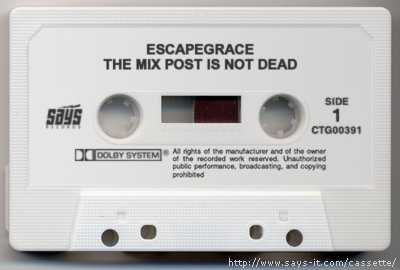
mix post: the mix post is not dead edition

After a crazy long hibernation, the mix post returns. Since the last outing marked the beginning of the year, it's only fitting this should mark the end. As much as I rankle at premature wrap-ups, I doubt I'll get around to another mix post before 2007, so hear ye, hear ye. These are a few of my favorite songs of the year. Released in 2006? Some. I don't know. It doesn't matter. This is about me.

Blue Veins - The Raconteurs @ KCRW & YouTube
I bought this album on a lark, and damn, if I'm not wearing it out already. This song is one of my favorites among many.

Could We - Cat Power @ rbally
The selection of this song is fairly random, because it's really the entire album that I love. My tickets to the Orpheum show tomorrow night glow with promise.

Diablo Rojo - Rodrigo y Gabriela @ MySpace & YouTube
If you had told me that I would have a thing this year for thrash metal-influenced flamenco guitar, I would have thought you were nuts. I would have been wrong.

Dimension - Wolfmother @ Veritas Lux Mea
This fills a deep arena rock need in me for which I will not be ashamed.

I Don't Feel Like Dancin' - Scissor Sisters @ Lost in Your Inbox & YouTube
Oh, but I do.

I'll Sing a Love Song to You - Candi Staton @ ortf
This is only one great song from the best contemporary soul album out there.

I Wish I Had an Evil Twin - Magnetic Fields @ Heartache with Hard Work
Stephen Merritt has certain moments of sheer genius and this is one of them.

Love Is Stronger Than Death - Angela McCluskey
You'll have to buy the album to hear her cover of this The The song, but you can hear the original here.

Sap - Freakwater
Sadly, there are no songs readily available from the latest album, including this song that breaks my heart every time, but WFMU does have this excellent cover of "War Pigs" instead.

Such a Lovely Thing - DeVotchka @ MySpace
The tuba, the fiddle, the slurred gypsy inflection...I can't get enough.

Think About the Good Times - Baby Washington @ WFMU's Beware of the Blog
A song has never been so happy and so sad at the same time.

Walking with a Ghost - The White Stripes @ La Blogotheque
This Tegan & Sara cover isn't necessarily special, but it gets to me.

Wolf Like Me - TV on the Radio @ Both Sides of the Mouth & YouTube
I can tell if this song is playing within a one mile radius by the way my head and hips are moving.
-

Wednesday, November 22, 2006

happy thanksgiving, kids

Turkeys Try to Catch Train Out of NJ:

A spokesman for the NJ Transit said train officials reported a dozen or so wild turkeys waiting on a station platform in Ramsey, about 20 miles northwest of New York City, on Wednesday afternoon. The line travels to Suffern, N.Y.

''For a moment, it looked like the turkeys were waiting for the next outbound train,'' said Dan Stessel, a spokesman for NJ Transit. ''Clearly, they're trying to catch a train and escape their fate.''

Transit workers followed the bird's movements on surveillance cameras. ''I have no idea how they got there,'' Stessel said.

********************

Tuesday, November 21, 2006

robert altman (1925-2006)

According to NPR, Robert Altman has died in Los Angeles.

Later tributes include The New York Times times two, the Chicago Tribune, and the Los Angeles Times, among many others.
-

findings: children do not like this man

Thanks to Lindsayism for the Scared of Santa Gallery...


Monday, November 20, 2006

I wanted these 'see librarian' books and I wanted them now

John Waters relates how Tennessee Williams saved his life:

Yes, Tennessee Williams was my childhood friend. I yearned for a bad influence and boy, was Tennessee one in the best sense of the word: joyous, alarming, sexually confusing and dangerously funny. I didn’t quite “get” “Desire and the Black Masseur” when I read it in “One Arm,” but I hoped I would one day. The thing I did know after finishing this book was that I didn’t have to listen to the lies the teachers told us about society’s rules. I didn’t have to worry about fitting in with a crowd I didn’t want to hang out with in the first place. No, there was another world that Tennessee Williams knew about, a universe filled with special people who didn’t want to be a part of this dreary conformist life that I was told I had to join.

Sunday, November 19, 2006

sunday short stack

"Before we set our hearts too much upon anything, let us examine how happy those are who already possess it." - Francois de La Rochefoucauld


Friday, November 17, 2006

I thought I heard the shuffle of angels' feet

This video for Johnny Cash's "God's Gonna Cut You Down" is chock full o' cool. Stereogum has the full list.

Thursday, November 16, 2006

animal magnetism

"The Life and Times of LaFontaine the Mesmerizer" from nthposition:

It's 1874, and he is having one of his usual triumphs. Huge and perfect, a demigod with a mountain of shining black curls on his head, he stands on the stage of the freshly built Paris Opera House.

The place is a neo-baroque marvel, with marble statues, jewel-studded arches, crystal chandeliers and gold-leafed pillars gleaming everywhere. The vast dome overhead features a fresco of God in his Heaven, being serenaded by hundreds of plump, rosy angels.


Several princes are in the audience, along with marquises, duchesses and various other continental glitterati of the time, each dressed more beautifully than the next. It's a capacity crowd, and they're all on their feet, loudly expressing their amazement, and their love, for Monsieur LaFontaine, the greatest of all mesmerizers.
-

Wednesday, November 15, 2006

to any female of respectability

These two Believer pieces have been up for a little while, but they're worth the link. Paul Collins, author of The Trouble with Tom: The Strange Afterlife and Times of Thomas Paine, gives credit for the creation of modern crime to a nineteenth-century journalist.

Curtis was the original shoe-leather reporter, with an encyclopedic intimacy with the streets of London and its denizens that came from an absolute horror of any form of locomotion save walking; he utterly refused to use a horse or coach. Once up from his armchair in his rumpled clothes, he invariably set out from his apartment to walk upward of eight miles in the predawn hours, starting out near his house at Farringdon Market, and making a peculiarly coiled loop—often retracing his steps several times over—through the vegetable sellers at Covent Garden Market, down through Hungerford Market, and milling with the famously foul-mouthed fishmongers at Billingsgate as they laid out Thames oysters, Scottish salmon, and Norwegian lobsters upon the stroke of their market’s 5 a.m. opening.

By the time he reached the opening of the Old Bailey, the sun was up and he was ready to write. The other reporters were only just now rubbing the sleep out of their eyes and stumbling in; none could hope to compete with Curtis, and they didn’t really try. Curtis alone recorded every trial, regardless of whether it had any news interest, quite simply because he liked to keep his own record of the court. Such a monumental task would have crippled the hand of any other journalist. But Curtis was known to have a fearsome ability at shorthand—he was so fast, in fact, that he published his own guide, titled Shorthand Made Shorter.

Curtis covered the conviction of a brutal killer, whose trial was seemingly as gruesome as his crime. The victim was a woman responding to an ad for matrimony, and The Believer also supplies samples of these responses.

[Sir,]

On taking up the paper this morning, your advertisement was the first thing that met my eye, and in seeing the word ‘Matrimony,’ I laughing said, a gentleman wants a wife, but I suppose he is in still greater want of money, otherwise he wishes to make himself warm this cold weather, by laughing at the credulity of the female sex… Having said all I have to say, I fetched a deep sigh, conscious, I suppose, of my own defects, and again looked at the paper without intending to do it. I read your advertisement through, and was not a little surprised upon finishing it; for, although there may not be one word of truth in it, it certainly wears the semblance of sincerity…. I repeat, if your tale is true, upon my word I pity you: if it is a fiction, I hope my sex may be revenged by your being obliged, at some future period, to pass a month, one month, in a house of discord….
*
Sir,

I beg to answer your advertisement of last Sunday, but really think it nothing but a frolic; I know a charming young woman of no property, her friends highly respectable, nineteen years of age, exceedingly agreeable person, has had the charge of her parent’s house these three years, and brought up by a truly amiable and virtuous mother. I can with great truth say the young lady is not aware of my answering your advertisement. If you think proper, you may address a line to Mrs. ‒—. I hope you will act honorably with regard to the name, as the writer is a married woman. A friend will put this in the twopenny post.

Your obedient servant,

[signed]

[P.S.] The young lady has never been attached to anyone, nor has she ever left her friends.