Sunday, April 26, 2009

festival of books 2009 - day two

Another lovely day at the Festival of Books. One of my panel posts - Fiction: The Writer's Ear - is up at Jacket Copy.

In response to a question about her style, Sarah Shun-lien Bynum related how she has been a lifelong word collector since fourth grade, when she began recording vocabulary on index cards. Her favorite word at the time was “luscious.”

Two more to follow shortly...Meanwhile, enjoy some photos from today's panels.


Fiction: Breaking Point (l to r: Antoine Wilson, John Wray, David Ulin, Hari Kunzru, John Haskell)


Enough About You: Humor and Fiction (l to r: Carolyn Kellogg, Ben Greenman, Seth Greenland, and Tod Goldberg)


Fiction: Closing Time (l to r: Carolyn Kellogg, Patrick DeWitt, Wells Tower, Jerry Stahl)

festival of books 2009 - day one

As I mentioned to someone yesterday, this is my favorite time of year: The LA Times Festival of Books. Switching things up a little bit, I am doing some panel coverage for Jacket Copy. (I have to say that having a press pass and green room access doesn't suck). You can look for posts over there and/or follow my Twitter stream for updates throughout the day. Below are some photos from yesterday's panels (and some post-festival cocktails).

Status Update: Social Networking and New Media (l to r: Andrew Nystrom, Otis Chandler, Wil Wheaton, Sam Wolf)

Fiction: The Writer's Ear (l to r: Julia Leigh, Laila Lalami, Sarah Shun-lien Bynum)

Publishing 3.0 (l to r: David Ulin, Sara Nelson, Richard Nash, Otis Chandler, Patrick Brown)
Publishing: The Big Picture (l to r: George Gibson, David Kipen, Bonnie Nadell, Kit Rachlis)

Guava Sin et al at W Hotel

Thursday, April 23, 2009

writing for nonreaders in the postprint era

This both tickles and rankles - Robert Lanham's Internet Age Writing Syllabus & Course Overview:

Instant messaging. Twittering. Facebook updates. These 21st-century literary genres are defining a new "Lost Generation" of minimalists who would much rather watch Lost on their iPhones than toil over long-winded articles and short stories. Students will acquire the tools needed to make their tweets glimmer with a complete lack of forethought, their Facebook updates ring with self-importance, and their blog entries shimmer with literary pithiness. All without the restraints of writing in complete sentences. w00t! w00t! Throughout the course, a further paring down of the Hemingway/Stein school of minimalism will be emphasized, limiting the superfluous use of nouns, verbs, adverbs, adjectives, conjunctions, gerunds, and other literary pitfalls...

Monday, April 20, 2009

j.g. ballard (1930 - 2009)

I was terribly sad to learn about J.G. Ballard's death yesterday. Ballard had a powerful influence on my scholarly work. At one point, I even pitched a book proposal focused on his work to the Contemporary British Novelists series at Manchester University Press. (Someone named Andrzej Gasiorek had the pleasure instead. Ballard was spared from "J.G. Ballard: A Philosophy of the Desiring Machine.")

Last night at the New Nonfiction reading at REDCAT, I learned of Ballard's death from David Ulin, who opened his reading with the piece that ran yesterday in the LA Times and is excerpted below.

It’s easy, from the perspective of the present, to minimize just how revolutionary all this was — we now live, after all, in Ballard’s world. Ballard, though, produced work that not only challenged his audiences but also actively provoked them, in some cases literally moving people to vandalism, as when he staged a 1970 exhibition of crashed cars at a London art gallery. This show, intended to illustrate the fetishization of machinery and violence, was a seminal moment for Ballard: It led to the publication of “Crash” in 1973.

“The marriage of reason and nightmare which has dominated the 20th century,” the author wrote in a 1974 introduction to the French edition of the novel, “has given birth to an ever more ambiguous world. Across the communications landscape move the specters of sinister technologies and the dreams that money can buy. Thermonuclear weapons systems and soft drink commercials coexist in an overlit realm ruled by advertising and pseudoevents, science and pornography. Over our lives preside the great twin leitmotifs of the 20th century — sex and paranoia.”

Ballard did as much as any other contemporary writer to define and even craft the world we live in. He will be missed.

Photo via Telegraph

Sunday, April 12, 2009

sunday short stack


"Books are not made for furniture, but there is nothing else that so beautifully furnishes a house." - Henry Ward Beecher


Friday, April 10, 2009

it is christmas time and I am sitting here by my TV

Ah, Bjork...you're electrical light.


Thursday, April 09, 2009

just enough money to live until the sun killed them

This week marked the 100th anniversary of John Fante's birth. Fante is most well-known for his novels featuring protagonist Arturo Bandini in LA's Bunker Hill neighborhood, such as the classic Ask the Dust. He is one of many writers to start to define the "new Californian" in the early 20th century.

The old folk from Indiana and Iowa and Illinois, from Boston and Kansas City and Des Moines, they sold their homes and their stores, and they came here by train and by automobile to the land of sunshine, to die in the sun, with just enough money to live until the sun killed them, tore themselves out by the roots in their last days, deserted the smug prosperity of Kansas City and Chicago and Peoria to find a place in the sun. And when they got here they found that other and greater thieves had already taken possession, that even the sun belonged to the others…These were my countrymen, these were the new Californians (Ask the Dust, 45).

The Hammer Museum hosted an event in Fante's honor on Tuesday and fans were invited to raise a glass at the King Eddy Saloon last night. (It is with great regret that I missed both of these events due to work obligations.) The LA Times' Carolyn Kellogg spoke with John's son, Dan Fante on the occasion of his father's birthday.

His father, Fante says, "was pretty much Arturo Bandini, only more intense...There was a compulsion and a passion and a drivenness and an ambition about my father that exceeded all his other characteristics," Fante adds. "My dad had two overriding moods. One was angry and the other was angrier." Now at work on a memoir about himself and his father, Fante explains that "what began as a very difficult relationship ended as an extremely loving relationship."

When he was 8 or 10, Dan brought him stories he'd written. John Fante, who hand-penned stories in the 1930s and later wrote screenplays before dawn, sitting in his shower stall and typing with two fingers, did not intend to make writing the family vocation. The feedback he gave his young son, Dan says, was "not good."

Stephen Cooper also wrote a piece for the LA Times, providing some background on Fante for those who may be lucky enough to have yet discovered him.

With a wife and four children to support, he cranked out treatments, screenplays and television scripts. Most proved forgettable and were never produced. For his efforts, he was accused of wasting his gifts.

Perhaps those who make such an accusation should be reminded that great novels are not made to order. Here is where the wonder deepens, for how are we to understand the unlikely convergences that, in late 1938 and early 1939, enabled Fante to write what many still consider the best novel ever written about Los Angeles, "Ask the Dust"?

Certainly his life lacked for no turmoil. Sixty years later, his wife Joyce would confide that when they weren't making love five times a day, they were often ready to kill each other.

Happy Birthday, sir.

Photo from johnfante.org

Sunday, April 05, 2009

sunday short stack


"Finishing a book is just like you took a child out in the back yard and shot it."
- Truman Capote


Friday, April 03, 2009

not like this should come as a surprise to anyone...

...who reads this blog regularly, but I dig the new Jack White project, The Dead Weather.


The new band takes White from the front of the stage back behind the drum kit, while the Kills’ Alison Mosshart mostly handles singing duties. The two are joined by White’s fellow Raconteur Jack Lawrence on bass and former touring Raconteur/Queen of the Stone Age Dean Fertita on guitar.


Thursday, April 02, 2009

what is the opposite of favorite?

Click to embiggen...

a mock commercial for zombie anti-depressants?

Paste Magazine surveys the imperfect art of the book trailer.

What is a book trailer? Consider it a marriage between the book jacket blurb and video. It's purpose is to act as a teaser in much the same way as a movie trailer. In fact, consider it a movie trailer. But for books. Still confused?

Sunday, March 29, 2009

sunday short stack


"Excess on occasion is exhilarating. It prevents moderation from acquiring the deadening effect of a habit." - W. Somerset Maugham


Wednesday, March 25, 2009

extreme sheep LED art

This does nothing to dispel my belief that people in Wales are slightly off and awesome.

Tuesday, March 24, 2009

ada lovelace & susan kozel

Today is Ada Lovelace Day, "an international day of blogging to draw attention to women excelling in technology." While there are many women who inspire me in this realm (...taking a brief pause to appreciate the twenty-first century...), I'm going to focus today on video artist/choreographer/theorist Susan Kozel. Kozel writes about "the physical experience of digital technologies to create new philosophical paradigms...Through her work, [she] researches the physical and philosophical vocabularies emerging from the convergence of dance and media technologies."

I have to give Kozel some credit for jumpstarting my personal explorations of technology about four years ago at the UC Riverside (Dis)junctions Conference. The highlight of the conference for me was the talk given by Kozel. She discussed her projects Trajets (involving video projected on screens that are choreographed to respond to participants walking on a sensored floor), Whisper, and Between Bodies ("wearables" that monitor participants' heartbeats, breath rates, and muscle contraction and transmit them through video or garments to other participants), among others.

Her latest book is Closer: Performance, Technologies, Phenomenology, out last year from MIT Press.

Monday, March 23, 2009

52 books in 52 weeks

7. Sleepless Nights by Elizabeth Hardwick

My trusted dissertation advisor recommended Sleepless Nights to me years ago, and now I know why. Hardwick refuses to conform to genre, offering what reads like a lyrical blend of fiction, memoir, poetry, journalism, and whatever else she fancies. The prose sparkles at the sentence level to the point I was unable to resist sharing excerpts with all who would listen.

8. U.S.! by Chris Bachelder

Bachelder deserves props for versatility and bravery in this strange and entertaining collection of "songs and stories" all centering around a repeatedly resurrected (post-assassination) Upton Sinclair. While the book is experimental in form, it's also heartfelt and wise. I look forward to whatever Bachelder gets up to next. (And who knew Sinclair was such a babe? See left.)

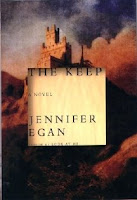
9. The Keep by Jennifer Egan

While not as deep or well-written as Egan's Look at Me, this gothic thriller/prison novel was a blast. It's a testament to the author's power of description that I can't remember the last time I could picture a setting quite as clearly.

10. Paradise by A.L. Kennedy

I read this novel about a young Scottish woman who also happens to be a raging drunk over the course of a day and a half, and I felt like I was on a bender with her. Considering little happens and the narration is filtered through a constantly replenished glass, the fact I couldn't put the book down says something. Unfortunately, I found the ending very unsatisfying.

10 down, 42 to go.