Sunday, May 06, 2007

sunday short stack


"Speak the truth, but leave immediately after." - Slovenian proverb


Saturday, May 05, 2007

a little whine and a moan

Lily Allen recorded a version of her song "Smile" in Simlish, the fictional language of Sims.


Friday, May 04, 2007

making nonsense of history

Apartment Therapy LA has posted Reyner Banham's 1972 BBC documentary on Los Angeles. It's seventy-licious!

american idol, lockdown style

LA Weekly's Joshuah Bearman profiles the “Inmate Idle Singing Con-Test” in an Arizona correctional facility.

With the close of auditions, the panel conferred and compared notes. It was often obvious who would or wouldn’t make the cut, but there were some borderline cases. And sadly, several of the panel’s favorites were either disqualified — violent offenders couldn’t compete — or got released too soon.

It was a constant problem, those pesky short sentences. One of the other star female singers had a missing tooth and wild hair, and came out shy like a frightened little mouse, but when she stepped to the microphone and “I Will Always Love You” rang out across the room, half the D.O.s swore it was “better than Whitney.” When the panel learned she would be out before the Inmate Idle finals, Thelda just about cried. She even had a sneaking desire to look at the girl’s record to see if she was a repeat visitor to the jail. Maybe she’d be back soon, she wondered, or perhaps they could bring her in on something outstanding? But then Thelda thought better of it. Bret was equally impressed by a guy who sang a Kid Rock ballad, but he was leaving jail the next day. “You want to come back for the finals?” Bret asked. Not surprisingly, the response was: “Dude, are you kidding?”

Thursday, May 03, 2007

reptile brains

David Byrne talks to Daniel Levitan, the author of This Is Your Brain on Music, about music, language, and memory.

DB: When somebody tells us what this song is about, or what this painting is about, we're kind of stuck because talking about the art, and the art itself, are almost separate areas. The music seems to have straight access to the so-called "reptile brain," and we feel it immediately. But often it's also touching all kinds of other parts of the brain. If it has lyrics, there's language in it. If it has a strong rhythmic element it's touching what you would call the motor parts of the brain and muscle. All kinds of stuff is involved. How do you think this all happens?

DL: My guess is it starts with trying to unite rationality with irrationality.

DB:
I'll bet you get resistance too from people who say you can't analyze this.

DL: Well, I remember a quote from Allan Watts, the philosopher. He wrote a number of books on Eastern philosophy in the 70s. He said that the problem with science is that when it wants to study the river, the scientist will go to the river with a bucket, take a bucket of water out, bring it to the shore, sit there, and study the bucket of water. But of course that's not the river.

And you know a lot of people have tried to study music by getting rid of everything except pitch or everything except rhythm. Or by using very strange, computer-generated sounds, to see what the brain does in response to them.

There's always this tension in science that you want to control your variables and you want to know what it is you're studying. And yet you want to have what we call ecological validity, which is just a fancy way to say it has to be like the real world. There's a tension between these two, and I've erred on the side of having ecological validity in my own experiments because I want to see the real phenomena.

the solitary bearer of a curse

Russell Banks on Colin Channer’s The Girl With the Golden Shoes:

We don’t see it attempted much these days, perhaps because American writers (and readers) are so blindered by standard-issue realism on the one side and escapist fantasy on the other, but Colin Channer’s The Girl with the Golden Shoes is a nearly perfect moral fable. It’s an ancient, essentially European literary form, the moral fable; but think of Hemingway’s The Old Man and the Sea or Thornton Wilder’s The Bridge of San Luis Rey. Think of Faulkner’s The Bear or Stephen Crane’s The Red Badge of Courage. Those are the modern American classics in the form. A more recent example is Cormac McCarthy’s The Road. Like them, The Girl with the Golden Shoes is a short narrative, shorter than a conventionally realistic novel, that is, but not so short as to be confused with a mere story. Like them, it’s set more or less outside of present time, yet is not meant to be read as historical fiction, and happens in a place that’s slightly outside the known or at least the familiar world. Even the title, The Girl with the Golden Shoes, calls to mind those old fables and fairy tales, pre-Christian European folk tales and medieval romances.

Wednesday, May 02, 2007

words online

I'm so late to the litblog panel after-party that I'm not even sure it's worth showing up, but I said I'd be there, it's on my way home, etc. For those of you who weren't there, the panel consisted of the four people above - Carolyn Kellogg of Pinky's Paperhaus, moderator Tod Goldberg, enfant terrible Andrew Keen, and Ron Hogan of Beatrice and Galley Cat.

I think everyone's in agreement that Andrew Keen acted like (is?) an elitist bully who wasn't interested in anyone else's thoughts on his main thesis: the internet is killing our culture (a.k.a. "the corrupting consequences of the democratization of media"). I find his attitude unfortunate because he is doing something that needs to be done: theorizing the future of the internet.

This doesn't mean that his idea that people aren't smart enough to tell good lit reviews from bad isn't spurious and insulting. Yet as I write this, I think about the students I teach online who are shocked (shocked!) that Wikipedia may not be an entirely reliable academic source. Things may not be as black and white as Keen would like us to believe. While Wikipedia is one of the most useful research tools a student could hope to find and I would go so far as to say the world is a smarter place for it, the cost of the dissemination of false information needs to be considered, even if in the end, it is dismissed as irrelevant.

Keen's other main point on Sunday - that bloggers are giving their content away for free in a bad business model that will eventually lead to their ruin - was equally overstated and almost immediately dated. The discussion is not necessarily whether or not the content should be free; it's how we manage this free content in a way that benefits both the content provider and recipient. Keen's idea that all "quality" content should have a price tag is abhorrent when I once again think about my online students who struggle to scrape together tuition payments. How can we even think about telling them that they'll also need to run up their credit card debt just to get some decent online reading material?

Obviously, the panel was on literary blogs and there was a focus on the question of whether blogs are destroying print media or the print medium is destroying itself. Keen has some thoughts on how our current print book reviews are adequate, which isn't even worth debating. I'd love to see figures on how much more lucrative book publishing has become for all authors now that online outlets like lit blogs can turn from the proscribed literary fiction chosen by the industry giants toward oftentimes more deserving, lesser known titles.

Favorite quote (tie, both from Ron Hogan):

"If I wanted to get rich, I certainly wouldn't be talking about books."

"There's a lot of shit to wade through, but there's a pony in there."

Monday, April 30, 2007

reports from the field

Another lovely day at the Festival of Books...

When oh when will I remember the best place to park? I've only gotten it right one year, and this was not the year. The only consolation for parking lot #3 is that you have to walk through the beautiful sculpture garden to get to the booths and panels.

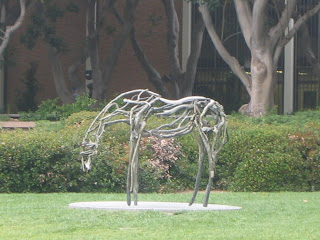
As a result of my parking snafu, I arrived about 15 minutes late for Inland Empire Fiction: The Other California.

Tod Goldberg moderated this panel inspired by the Inlandia anthology, which includes Tod and the other three panelists: Susan Straight, Michael Jaime-Becerra, and Gayle Brandeis. Some of the topics discussed were the changing environment around the peace movement, Darby Crash, secretive mother-in-laws, tract homes (natch), National Novel Writing Month, self-storage auctions, folk art dinosaurs, bad air (natch), the Salton Sea, parrots, the evil god of Tahquitz Canyon, the nudist colonies of Riverside, summer homes of the KKK, citrus groves (natch), Hell's Angels, White Front, and Trafficula. The mythologies around the Inland Empire are still being formed (and certainly, not enough has been made of its designation as an empire), so the panel (and presumably the anthology) have begun the discussion as a survey with the analysis sure to follow as the genre develops.

Favorite quote:

"The wind blows; that's sex." (Susan Straight discussing The Sex Life of the Date)

I wandered around a bit before attending the conversation between David L. Ulin and Jane Smiley. I am somewhat embarrassed to say that I've never read a single book by Ms. Smiley, but I am intrigued by her latest - Ten Days in the Hills - a contribution to my growing bookshelves of contemporary LA fiction. For that reason alone, I am likely to read it, but I will now make it a priority because I was impressed and entertained by almost everything Ms. Smiley had to say (and that Ulin's no slouch). Topics discussed included the Decameron (to be expected considering Ten Days is structurally based on Boccaccio's classic) and the lesser known Heptameron, the idea of writing overtly about sex as a political statement, the idea of being apolitical as a political statement, exchanging structure for plot as organizational framework, the finger of the plot in one's back, Robinson Crusoe, confessions of hanged men, empathy, chick lit, paperback originals, dating yourself through topical subjects, Zola's The Ladies' Paradise, fiction after September 11, and whether the administration's reaction to Hurricane Katrina would have been different if they had read Their Eyes Were Watching God.

Favorite quote:

Jane Smiley: "[Sex] sells papers."
David Ulin: "Something has to."

I left a bit early to get over to the purported smackdown panel, Litblogs: Words Online, once again moderated by Tod Goldberg. Andrew Keen has seemingly enraged the blogging community with his forthcoming polemic, The Cult of the Amateur: How Today's Internet Is Killing Our Culture. Keen was in attendance, and litbloggers Carolyn Kellogg and Ron Hogan rounded out the discussion. Work obligations prevent me from doing this panel justice at this time, so thoughts will follow tomorrow.

The audience was full of local bloggers, and while I missed Callie (do you look like your photo?), I had the chance to chat with Carolyn at the Book Soup booth later. You can read her report of the panel here.

The rest of the day involved a surprisingly delicious chicken caesar wrap with a friend, spending way too much money, running into random acquaintances, and starting the countdown of another 51 weeks until the next Festival of Books.

Sunday, April 29, 2007

sunday! sunday! sunday!

After a crazed day of nonstop work yesterday, I am now free to enjoy the Festival of Books! Reports from the Inland Empire and litblog panels to come as well as the talk between David Ulin and Jane Smiley.

Losanjealous has an amusing list of "editorial picks" for the panels, such as Saturday's 3:30 offering "Book Fair Panels: How to Monopolize the Q&A portion with Your Inane Questions" and today's don't-miss panel "How to Write 'L.A. Fiction': Sunshine, Traffic, Superficiality, Hollywood, blah, blah, blah…"

Friday, April 27, 2007

stories from the book shelf scan

Callie at Counterbalance reflects on a subject that hits close to home: book snobs and the lies they tell.

I know several bloggers of all stripes (lit, design, music, etc.) who don't list certain books in their "just read" or "currently reading" columns. Sandra at Book World (who has just made a lovely shift in her blog from covering books to covering writing and books about writing) mentions that she would never place these books about writing in her left-hand column. Instead of gasping at her declaration, I thought: my god, I do the same thing...

My next thought was: well at least I don't pretend to have read books that I haven't. That seems a far worse offense. Or is it? Isn't the shame -- for those who haven't read something they feel they should & those who've read something they'd rather not advertise -- and the hiding of said shame, equal on both sides? I wonder. While I continue to probe this question & my own guilt (no doubt induced by a brand of crazy that only my christian school education could provide), I reserve the right to leave these aforementioned read-but-not-going-to-admit-it books off my public "Books I've Read List."

Guilty. Guilty. Guilty. I am actually trying to meet a somewhat difficult goal for someone with two jobs - 52 books in 52 weeks - and when I delve into the occasional self-help book because let's face it, I need help, I don't list it! What kind of help is that? And boy, do I check out other people's book shelves. I've yet to end a friendship over it, but one friend's Nelson DeMille collection haunts me. I thought I was at least off the hook for lying about things that I haven't read when I realized that just the other day I was asked if I had read a particular classic, and I replied, "Parts of it." Parts of it?? Where do they publish parts of a novel? Did I travel back to the nineteenth century and read it in serial form? For that matter, am I in the habit of beginning books and not finishing them? Not even. Ah, I have seen the lying book snob and the lying book snob is me.

Thursday, April 26, 2007

time is a strange mistress

Spinal Tap reunites to call attention to climate change.

portable night pots carried in ladies’ muffs

At the OUPBlog, Anatoly Liberman looks at the etymology of the word "loo":

French l’eau “the water” has been offered as the etymon (source) of loo. In the 19th century, it was common to invent French etymons of English words and explain the discrepancy in the pronunciation as the result of English speakers’ inability to produce foreign sounds. But surely, law or low are more accurate renderings of l’eau than loo. And why should loo have been borrowed from French, a language that lacks its equivalent? Engl. ablution contains the syllable loo, and so does Latin ablui “I have washed off.” If loo originated at Oxford and Cambridge, bookish word play could be considered. However, as noted, we do not know the social stratum in which loo was coined.

Since the abbreviation for water closet is WC, loo resembles the second half of double u, but loo, definitely not an “Americanism,” has never been pronounced like British lew (that is, with the sounds of few, pew, cue) even in the United States, let alone England or Scotland. The same objection holds for the attempts to derive loo from lee “shelter,” reportedly pronounced somewhere as lew, and from the phrase in lieu of. Lavatories are often named for people. Engl. john is a classic example; its predecessor was jakes. In Germany, Tante Lotte “Aunt Lotte” and many other similar names have been attested. It would be nice if Uncle Lou, the eponymous ancestor of British toilets, were discovered, but so far he has not turned up. According to one version, during a house party in Ireland, about 120 years ago, Lady Louisa Anson’s two younger sons put her name card on the guest lavatory. Henceforward, highbrows (or so we are informed) talked of going to Lady Loo. Perhaps they did, but, to the best of our knowledge, this piece of aristocratic slang has left no trace in any story or newspaper article, and no member of the British nobility seems to remember it. We may forget it too.

Wednesday, April 25, 2007

bowie nicked all your stuff

Didn't we all slave away in an '80s band before we settled into our office jobs?

one of the more noble functions of human intelligence

Hermione Lee looks at a stack of books on the Novel.

The novel's entanglement in "the prose of the world" can also be its justification and its pride. The novel's virtue, it has often been argued, lies in its egalitarianism, its very commonplaceness. And the novel's everydayness need not be an enemy to its aesthetic integrity. In his wise, deep, and witty essay on the novel, The Curtain, Milan Kundera, a follower of Flaubert in his critique and practice of the European novel, celebrates "the everyday" ("it is not merely ennui, pointlessness, repetition, triviality; it is beauty as well") while writing in praise of the novel's essential self-sufficiency:
It...refuses to exist as illustration of an historical era, as description of a society, as defense of an ideology, and instead puts itself exclusively at the service of "what only the novel can say."
Kundera's celebration of the novel's freedom and self-sufficiency makes essential reading in a long history of debates about the genre. Ethical and aesthetic controversies over the novel have gone on for many centuries—the number of centuries depending on whether you think the novel came into being in the early eighteenth century, or (as Walter Benjamin does) coincided with the invention of printing at the end of the fifteenth century, or was lurking in Egyptian demotic narratives of the seventh century BC or Greek romances from the first century AD. Every so often these long-running debates are accompanied by prophecies of doom: the novel is dead, the novel is drowning in a dizzying virtual universe of instantaneous, interactive information, the novel is having to compete for readers in "a world in which millions of books are dumped in the market place at once."

they don't praise the shadow

Are you able to tell the difference between machine-translated German text and Faulkner?