Tuesday, August 22, 2006

a great liquid whip

The internets are abuzz about David Foster Wallace's appearance in the New York Times this weekend, writing about tennis star Roger Federer as religious experience.

Of course, in men’s sports no one ever talks about beauty or grace or the body. Men may profess their “love” of sports, but that love must always be cast and enacted in the symbology of war: elimination vs. advance, hierarchy of rank and standing, obsessive statistics, technical analysis, tribal and/or nationalist fervor, uniforms, mass noise, banners, chest-thumping, face-painting, etc. For reasons that are not well understood, war’s codes are safer for most of us than love’s. You too may find them so, in which case Spain’s mesomorphic and totally martial Rafael Nadal is the man’s man for you — he of the unsleeved biceps and Kabuki self-exhortations. Plus Nadal is also Federer’s nemesis and the big surprise of this year’s Wimbledon, since he’s a clay-court specialist and no one expected him to make it past the first few rounds here. Whereas Federer, through the semifinals, has provided no surprise or competitive drama at all. He’s outplayed each opponent so completely that the TV and print press are worried his matches are dull and can’t compete effectively with the nationalist fervor of the World Cup.
-

toothpaste for dinner

After helping my cousin build a truckload of IKEA furniture, I was wildly amused by this comic from Toothpaste for Dinner. If you haven't discovered the fruits of Drew's imagination, you're in for a treat.
-

Sunday, August 20, 2006

clell tickle: dream weaver

The latest from the hilarious mind of Aziz Ansari (and my triumphant first attempt at embedding You Tube, marred only by my embarrassment that it was so easy and took me so long):


-

sunday short stack

"Never before had I believed or suspected that I had a soul but just then I knew I had. I knew also that my soul was friendly, was my senior in years and was solely concerned for my own welfare. For convenience I called him Joe." - Flann O'Brien, The Third Policeman

  • I'm looking forward to the release of the Mountain Goats' new album, Get Lonely, on Tuesday and their appearance at Amoeba Hollywood on Wednesday. I heard a preview of the album at their show in LA a couple of months ago and the song "Half Dead" broke my heart. Via Rake's Progress, here's an interview with John Darnielle at the Village Voice.
  • The Areas of My Expertise will not teach you how to read, my feral mountain man friend, but you should buy it anyway.
  • This Fun Movie Quiz is a great way to pass the time (via Ed Champion).
  • If Bukowski thought Mickey Rourke was too theatrical (read: pretty) to play him, what would he possibly think about Matt Dillon?
  • Pete Doherty's mom cashes in on her son's efforts to embody recidivism (via Perez Hilton).
  • I'm terribly sad to be missing Brooklyn's first official Book Fest, featuring Mr. & Mrs. Foer Krauss, Rick Moody, Jonathan Lethem, Colson Whitehead, and Jhumpa Lahiri (via Maud Newton).
  • Adam Kirsch uses Walter Benjamin's relationship with hashish as a starting point to look at his literary criticism: "It is characteristic of Benjamin that the first fact he thought it necessary to record was not the time he had taken the drug but the time he started writing about it."
  • Panoptocist has a great post on "the Wilhelm scream" and its storied past.
  • Apartment Therapy LA points to a nice photo collection of the actual hardware of Los Angeles addresses as well as this great quote from Clive James: "Prejudices are useless. Call Los Angeles any dirty name you like...Six Suburbs in Search of a City, Paradise with a Lobotomy, anything...but the fact remains that you are already living in it before you get there."

when politics and literature collide

There was much ado this week in response to Nobel Prize winner Gunter Grass's admission that he served in the SS as a teenager. The general consensus seems to be that the problem is not his association with the Nazis, but his smug hypocrisy for the rest of his life. Meanwhile, the family of Wizard of Oz creator L. Frank Baum has apologized this week for racist op-eds he wrote in South Dakota that may have catalyzed the Wounded Knee massacre (via bookslut). Finally, there has been much commentary on Bush's choice of vacation reading: Albert Camus's The Stranger. (Cue The Cure.) Slate tries to get to the bottom of Bush's selection...

Whatever the reasons, Camus' story line is ripe for geopolitical literary misinterpretation. The main character, Meursault, spends much of his life as the young George Bush did, engaging in escapades that demonstrate little drive or motivation. On a visit to the beach with friends, he gets into a fight with some Arabs. Later, he finds one of the Arabs and without much further provocation shoots him repeatedly. During the circus-trial that follows, and the long hours Meursault spends in jail, he is remorseless and unable to engage in contemplation. On the day of his execution, he has a flickering thought that he might have lived another life. But mostly he's excited about the day and hopes that everyone will cheer for his death.

...and Salon publishes Bush's book report. As usual, however, Jon Stewart cuts to the heart of the matter.
-

Saturday, August 19, 2006

devotchka @ troubadour

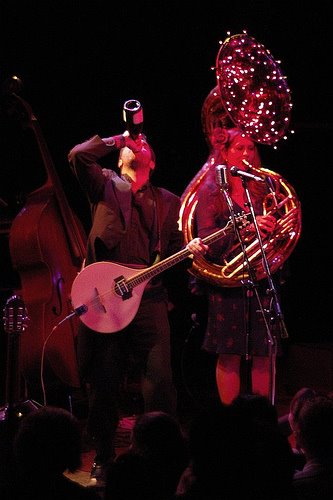
After about a year of never being able to get the song "Such a Lovely Thing" out of my head, I finally got to see it performed live at the Devotchka show last night at the Troubadour. What I thought would be the highlight was just one of many as these Denver musicians rocked the house. (I've decided my habitually poor concert photos are a result of my reluctance to squeeze through the crowd and get closer to the stage. Oh well.)

Singer Nick Urata had a guitar playing/dancing move that was damn near irresistible to this audience member, but the other musicians were equally impressive, especially Jeanie Schroder who alternated between the upright bass and a Christmas-light festooned tuba, as seen in this photo from the band's website.

If you're in the Southwest or New York, you're in luck. Their tour continues through September.

-

requisite david mitchell post

My...um...fondness for David Mitchell is well-documented, and his inclusion in the Booker longlist is a perfect opportunity to link to some of his recent activities. You can listen to audio interviews here and in two parts at the Bat Segundo Show here.

Part I:

Subjects Discussed: The similarities between Jason Taylor and David Mitchell, idiosynchratic vernacular, first-person vs. third-person voice, index cards, how Granta unexpectedly kicked off Black Swan Green, the correct pronounciation of Nabokov, the difference between sandwiches in the US and the UK, the use of 1980s technology in writing, the Falkland Islands, on selecting cultural references from 1982, Friendster, the regulation of UK schools over the past thirty years, the use of visual elements in BSG, authenticity, money and Thatcher’s England, MacGuffins in novels and life, being nice to horrid people, the Julia principle, the politics of language, hip-hop culture, the threat of conformity vs. Jason Taylor’s resilience, shaking off the Murakami yoke, the Ed Park review, on using characters from other books, and naming the headmaster Nixon, and character names that “stick on the eyeball.”

Part II:

Subjects Discussed: The Simpsons, the ambiguity of Norman Bates, transcontinental reception, the unexpected reception of Black Swan Green, the Stranger review, Haruki Murakami, finding auctorial voice, the “fourth book” breakthrough, avoiding the pitfalls of commercial writing, laziness, stylistic restraints and imagination, politicians, flexible opinions, compartmentalizing narrative components, conclusions of novels, the perfect songs, the Beatles, information on the fifth novel and the kind of book Mitchell is shooting for.

Mitchell also appeared on KRCW's Bookworm last month. Counterbalance provides extensive four-part coverage of the reading I attended in April. The Telegraph and The New Republic have reviews, the latter of which also covers the challenge of reviewing a book you like:

Bad reviews are motivated by anger, but good reviews are motivated by love; and it is easier to become angry than to fall in love. Every reader had a first love, most likely in childhood: a book that we could not get enough of, and guarded selfishly for fear that someone else might come to think of it as their own; a book with which we identified completely; a book to which we probably would not want to return as adults for fear that it might not live up to our memories. Perhaps we were serial monogamists, who exhausted the entire work of one author only to move on to another the next month or year. Perhaps we were polygamists, who could not be satisfied by one book at a time, but had to have many all at once, from different genres and different time periods. But whatever our inclinations, over the years our capacity to love books becomes dulled by repeated frustration. Every time we pick up a book, we expect to fall in love; but after a certain number of disappointments, our expectation turns to mere hope; and eventually we give up even that.

But no true reader ever gives up entirely. We still want to be moved deeply; we are still looking for books that, as Orwell put it, will burst the thermometer. But for the critic, finding such a book brings its own set of problems. Falling in love, even with a book, makes you vulnerable, and most of us are not inclined to parade our vulnerabilities in public. Even worse, falling in love makes you blind to faults; and so you find yourself overcompensating, looking for flaws where none exist. Also, as a reader it is wonderful to be alone with your love, but the reviewer has a professional obligation to sing a good book's praises from the mountaintops. But how do you convince anyone that you have found "a novel of real merit" when the simplest phrases ("I liked it") are boring and the elaborate ones ("superbly matchless") have lost their meaning?
-


Friday, August 18, 2006

mainstream journalism has become a joke

Jessica Clark looks at Comedy Central's role in contemporary politics:

This evolution of political comedy has everything to do with the collapse of public trust in our truth-telling institutions, hastened by the right’s sustained attack on what one GOP insider dismissed as the “reality-based community.” (“Reality,” quips Colbert in full conservative drag, “has a well-known liberal bias.”)

We now routinely watch the mainstream media with the expectation that we’re being spun, but when did we start watching comedy for the real deal?

pass the valium canapes

Ed Champion has posted the Literary Hipster's Handbook - 2006 Q3 Edition:

“Booker nod”: A literary event with tiresome results, often producing soporific qualities in the participant. Named after the predictable nature of the 2006 Booker Award longlist, but recently expanded to include bookstore events, boardroom meetings, and drab cocktail parties. A legitimate Booker nod must involve someone falling asleep, thus signaling to other hipsters that the event should be avoided at all costs.

Note: The Booker longlist was announced on Monday.
-

Wednesday, August 16, 2006

rich friends...poor us

L to R: Sandra Tsing Loh, Meghan Daum, Nicole Holofcener

There was a gem of an event last night at the National Center for the Preservation of Democracy, housed in a shiny, immaculate building between the Japanese American National Museum and the Geffen Contemporary downtown. Writer Meghan Daum had been given the reins by Zócalo and KPCC to invite anyone she chose to discuss anything she chose. The result was Daum, writer/performer Sandra Tsing Loh, and (escapegrace favorite) director Nicole Holofcener in conversation about the topic "Rich Friends, Poor Us: Is Status Anxiety the Newest Form of Depression?"

The title question wasn't exactly addressed, but many other engaging ideas were: Is the middle class identified by its anxiety about class? Is class defined by money? Education? Lifestyle? Is Gore Vidal the classiest person in LA? How do filmmakers deal with the need to portray realistic apartments in New York? Is class different in LA than it is in New York? Is the creative class its own class? Do rich friends have to be fancy friends? Is the word "classy"
déclassé? How is the experience of class different for women? Can only rich people be jewelry designers? Does college have any connection to class any longer? Does parenthood put the trappings of class on display? Are working mothers more anxious about having classy children? Do Americans still believe they can go from rags to riches?

The entire conversation will eventually be broadcast on KPCC and possibly available via podcast here.
-

Tuesday, August 15, 2006

here we go again

Last summer, I couldn't get enough of OK GO's video for "A Million Ways" and their synchronized silliness. Now the boys return to my heart with more funky footwork in a new video for "Here It Goes Again" - this time on treadmills!
-

Monday, August 14, 2006

not the pick of the litter

This photo most accurately captures the absurdity of Boy George's community service today in New York.

Photo via Perez Hilton

the '90s are over & we're never getting them back

At Slate, Marisa Meltzer bids farewell to Sleater-Kinney.

One day, driving in a friend's car, I heard 2002's One Beat and I realized that Sleater-Kinney had grown up and moved on as much as I had. The album sounded like it was made by thirtysomething women who were still frustrated by the status quo—and played louder than ever to prove it—but you could hear that they were living with children and mortgages and standing weekly therapy appointments. Their last and arguably best record, The Woods, came out last year and has a certain finality to it, packed with songs about the complications of success and long-term relationships, ending with the warped lullaby "Night Light," as if they knew all along it would be their last one.
-

Sunday, August 13, 2006

sunday short stack


It was so nice to weed my bookmarks last Sunday that I'm going to make it a weekly tradition.


Thursday, August 10, 2006

civic pride and ballyhoo

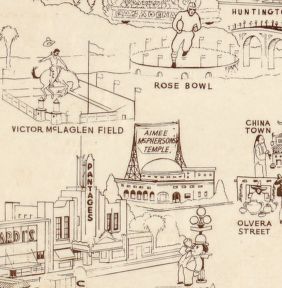
A current exhibition from the Library of Congress presents historical maps of Los Angeles - both at the Disney Concert Hall (the only LOC exhibition venue located outside of DC) and here at Los Angeles Mapped. Above is a detail from a 1937 "official moviegraph of the land of stars, where they live, where they work, and where they play" (copyrighted by Don Boggs). As you can see, the map also includes "where they worship" in the form of "Aimee McPherson's Temple" a.k.a. the Angelus Temple. (See the full map here.)

Aimee Semple McPherson is credited with an impressive number of firsts. She is thought to be the first woman to cross America in an automobile without a man’s help. She was the first woman to lead a religious service in London’s Royal Albert Hall, the first woman to preach a sermon over the “wireless telephone,” and the first woman to receive a commercial license from the FCC. She founded the first religious broadcasting station, KFSG (Kall Foursquare Gospel), preaching to hundreds of thousands of people daily. McPherson was the first evangelist to bring revivalism into large-scale commercial stadiums. She preached in more than 100 cities and towns from 1917 to 1923 and later alleged that she gave more sermons than any preacher who ever lived. The evangelist was even made an honorary colonel by the U.S. Army.

(Thanks to SH for the link...)