Tuesday, May 23, 2006

as a premier source of human meaning
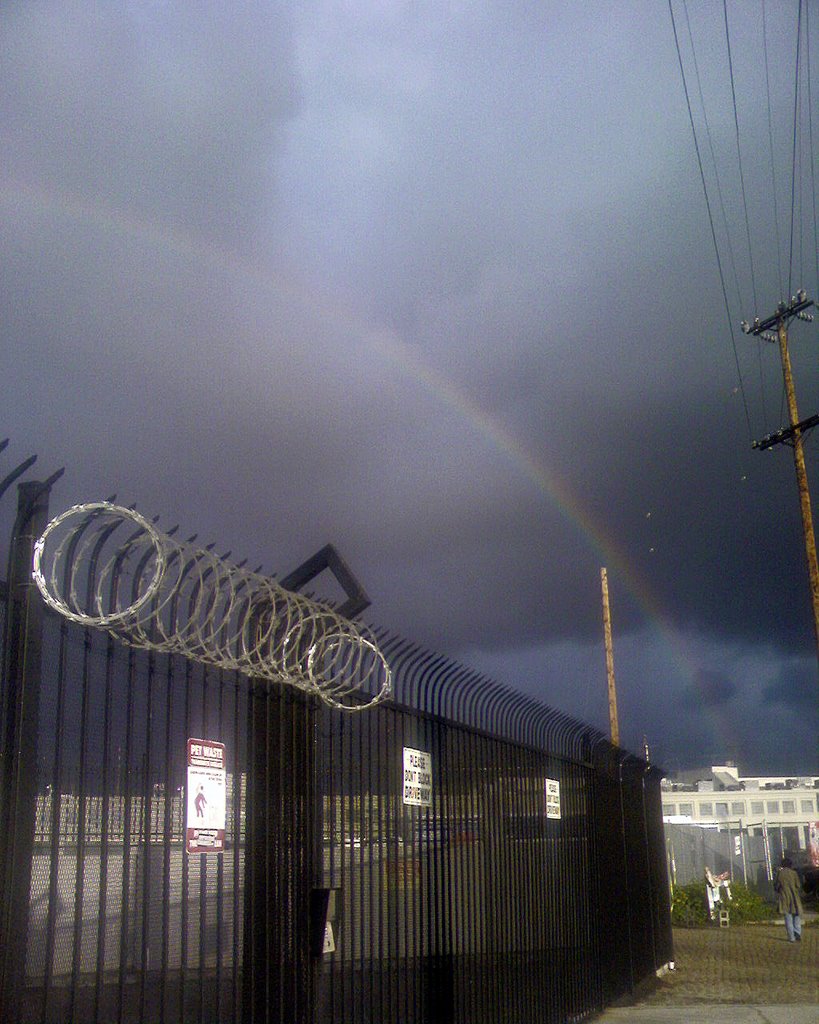
This essay by Jenny Price in The Believer has been out for awhile, but it's still worth posting on this first purely sunny morning in ages: "Thirteen Ways of Seeing Nature in L.A."

More urgently, L.A. is the ideal place to tackle the problem of how to write about nature. In the past twenty-five years, the venerable American literature of nature writing has become distressingly marginal. Even my nature-loving and environmentalist friends tell me they never read it. Earnest, pious, and quite allergic to irony: none of these trademark qualities plays well in 2006. But to me, the core trouble is that nature writers have given us endless paeans to the wonders of wildness since Thoreau fled to Walden Pond, but need to tell us far more about our everyday lives in the places we actually live. Perhaps you’re not worrying about the failures of this literary genre as a serious problem. But in my own arm-waving manifesto about L.A. and America, I will proclaim that the crisis in nature writing is one of our most pressing national cultural catastrophes.

Photo by Mason

our gorgeous friends in their gawky adolescence

The latest edition of Bookforum features a look at the first novel by Craig Seligman with recollections from William H. Gass and Jonathan Lethem, among others.

"She had dragged a heavy gun to the front; she determined to fire her shot." The woman in question is a wealthy widow who's been spoiling for an argument when—unexpectedly, disappointingly—her adversary backs down. The improbability of the image, slightly absurd in its ponderousness, marks its provenance instantly: This could be a sentence from The Golden Bowl. It comes, in fact, from Watch and Ward, written in 1870, serialized in the Atlantic Monthly the following year, revised and published between hard covers in 1878, and then forgotten; and it's a delight to find that on his first foray, at the age of twenty-seven, Henry James is already so thoroughly Henry James. Watch and Ward is an unassuming book, the opposite of Adam Bede in ambition and scope. But its felicities are many and its flaws are few.

Thursday, May 18, 2006

how I write my novels

Books. Everyone reads them. Everyone loves them. And everyone would love to write them. But writing books is just too hard. Or at least that's what some people want you to think.

Tuesday, May 16, 2006

pounded and dazzled and astonished and beaten and broken and rescued and illuminated and rewarded and humbled

In this past weekend's West, David L. Ulin argues that Charlie Kaufman has become one the best writers of his generation.

For me, "Adaptation" is precisely such a work, a strange and remarkable movie that offers the most accurate portrayal I've yet seen of what it's like to be a writer. It's also a compelling riff on narrative structure, on the intricacies of art and commerce, the difficulty of storytelling by committee and the universal human desire to be liked. Based on Susan Orlean's 1998 nonfiction book "The Orchid Thief," it is an investigation of obsession, of the elaborate, looping interplay of the author's mind and his material and, indeed, himself. "Do I have an original thought in my head?" the film begins, as Kaufman—or Nicolas Cage, who plays both Kaufman and his brother—murmurs in a voice-over, while credits flash across the bottom of a black screen. A minute later, we're on the set of "Being John Malkovich," where Kaufman/Cage is waved off the soundstage after getting in the way of a shot. "What am I doing here?" he wonders. "Why did I bother to come here today? Nobody even seems to know my name. I've been on this planet for 40 years, and I'm no closer to understanding a single thing. Why am I here? How did I get here?"

Via The Elegant Variation

The weekend LA Times also featured a review of Carolyn See's new novel There Will Never Be Another You, being released today.

As the world around these people spins out of control, so too do their own lives, with illness, death, divorce and heartbreak served up in rapid succession. Personal tragedy reflects global uncertainty, or vice versa — it depends on where in the novel you find yourself. See lets us know we can't control either one, then soothes us with the optimism that is her ultimate gift. When the scholar's daughter, Andrea, and Danny, a boy from the Chinese family, fall in love, it's a sweet relief. Here, in the bushes and bracken where they hide to make love, angst and anxiety suddenly fall away. This is young romance, after all. It gives a flash of logic to the querulous world See has pressed upon us, and we're relieved, even grateful.

You can download a version of the song from which the novel takes its title here.
-

Monday, May 15, 2006

sell outs and stanzas

At the Contemporary Poetry Review, Kathleen Rooney takes a look at how well the rock star fares as a poet, featuring reviews of David Berman, Billy Corgan, Mike Doughty, Art Garfunkel, Damon Krukowski, Paul McCartney, Lee Ranaldo, Patti Smith, and Jeff Tweedy.

According to Stephen Burt, in his essay “‘O, Secret Stars, Stay Secret!’: Rock and Roll in Contemporary Poetry,” we harbor numerous “assumptions about the differences—no, the contrasts—that separate poetry from rock and roll. Rock is easy, poetry hard to create. Rock is spontaneous and simple; poetry intricate, enduring, reflective. Rock is ephemeral, while poetry endures. And rock songs (for all those reasons) belong to the young, as poetry maybe did once but sure doesn’t now—or so we assume”. He goes on to argue that poetry to some extent craves the immediacy, spontaneity, fame, and—let’s face it—youthful hipness of rock and roll; poetry, or at least certain young poets, want to be cool. And while it is interesting to examine, as Burt does, why and how poets can be seen to covet rockstardom (or at least the trappings thereof) and how they incorporate elements of rock and roll into their poetry, it’s equally fascinating to explore a somewhat more puzzling phenomenon: recently multiple indie rock musicians have been seen to covet the power of poetry to such an extent that they are bringing out collections of their own, in some cases under the auspices of prestigious literary presses. In flipping Burt’s equation and examining its less obvious side, I would argue that just as certain poets long for rock’s visceral immediacy and audience, certain rock stars long for poetry’s durability, thoughtfulness, intimacy, individuality, outsider status and intellectual cachet. I would also argue that despite their evident differences, these two seemingly disparate art forms are actually more closely allied than the casual observer may perceive.

Again...Via Bookslut

you leave me no choice

Back in the day, I attended Boston College for a bachelor's degree in political science, and I've since held a grudge against the university, specifically its English department chair. When I asked to pay them to take one summer course that would qualify me for a double major in English because I planned to pursue graduate work in English (resulting in my recent Ph.D.), the chair basically said she wasn't going to fall for my ploy to raise my hardly shabby GPA - because we all know how much one course can cause your GPA to skyrocket.

So I've always wondered how exactly Steve Almond fit in there. Apparently, not that well. He has just resigned his teaching position following the university's announcement of Condoleeza Rice as the commencement speaker.

Many members of the faculty and student body already have voiced their objection to the invitation, arguing that Rice's actions as secretary of state are inconsistent with the broader humanistic values of the university and the Catholic and Jesuit traditions from which those values derive.

But I am not writing this letter simply because of an objection to the war against Iraq. My concern is more fundamental. Simply put, Rice is a liar.

She has lied to the American people knowingly, repeatedly, often extravagantly over the past five years, in an effort to justify a pathologically misguided foreign policy.

Via Bookslut

Tuesday, May 09, 2006

requisite jack white post

It's sad to think how estranged Jack White & I have become since his marriage to Karen Elson and subsequent procreation. I haven't posted anything about him for ages. Here are some links to his latest exploits:

The debut from his side project The Raconteurs, Broken Boy Soldiers, will be released next week.

The Guardian interviews White with fellow Raconteur Brendan Benson and reviews a UK show.

In actual fact, Benson and White met in 1998, when the former attended a White Stripes show. "I was conspiring to meet him," admits Benson. "I just went to the show, and I remember paying to get in and I could hear the band playing and it sounded like a woman, I thought. And then I turned a corner and I saw Jack up there singing these unbelievable songs. I was literally stunned. Mouth gaping. And I just made it a point to meet him." Their first encounter was, they recall, slightly awkward. "You said, 'I can't believe you remembered all the lyrics to Isis,'" recalls Jack, deadpan. "Then it was, 'Do you come here often?'"

YouTube has White's new Coke commercial.
-

Monday, May 08, 2006

I just keep seeing him swimming in the bay

The first chapter of Philip Roth's new novel Everyman is up at the New York Times site.

You can read a review from John Dicker here and David Ulin here.
-

Sunday, May 07, 2006

Saturday, May 06, 2006

52 books in 52 weeks (sort of)

I'm reposting the April 15th post below with brief additional descriptions...

I'm going to bite Largehearted Boy's style and join the ranks of those participating in his annual project to read 52 Books in 52 Weeks. Now, I know you may be saying, "It's Week 15! Where have you been?" Well, I've been on a sabbatical from pleasure reading, but now I'm back and up for the challenge. I did manage to fit in some fiction here and there since 2006 began, so without further ado, I'll begin.

1. The History of Love by Nicole Krauss

From what I can gather, if you read Extremely Loud and Incredibly Close first, you like that novel better and vice versa. There is some credence to the argument Mr. and Mrs. wrote the same book, both excellent.

2. On Beauty by Zadie Smith

Smith has a remarkable ear for dialogue that alone makes this book worth reading.


3. The Best American Short Stories 2005

Michael Chabon's taste is more apparent than any previous editor of the series, but this is not necessarily a criticism.

4. Veronica: A Novel by Mary Gaitskill

Gaitskill's style is not for me: too much self-conscious darkness.


5. Twilight of the Superheroes: Stories by Deborah Eisenberg

The title story is a remarkable entry in the September 11th genre.


6. This Minute by Jean Gallagher

A book from a friend, rife with spiritual and intellectual resonance - buy it or try Stubborn.

6 down, 46 to go.
-

Thursday, May 04, 2006

take off your skin and dance around in your bones

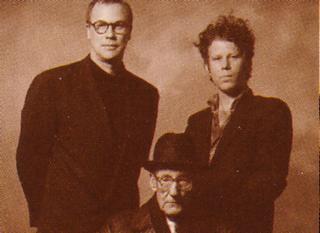
As if the Festival of Books weren't enough, I also had the opportunity to see a theater production for which I've been lusting for a decade: the Tom Waits/William Burroughs/Robert Wilson collaboration The Black Rider: The Casting of the Magic Bullets at the Ahmanson. The theater is part of the downtown LA Music Center (seen in the photo above), a lovely oasis filled with outdoor bars, trees full of lights, live salsa bands, and two separate venues. Even without tickets to an event, it would be a nice place to pass some time.

The Black Rider was first produced in 1990, and a few years later, I picked up the CD, relishing Waits's music and lyrics and Burroughs's odd textual stylings. I had missed any chance to see the production until now. I was lucky enough to see Woyzeck, another Waits/Wilson collaboration, at BAM in 2002 and it whet my appetite for more - more of Wilson's fabulist dreamscapes and more of Waits's trademark carnival genius. (Waits's 2002 release Blood Money features music from Woyzeck, including the haunting "God's Away on Business.")

In the program for The Black Rider at the Ahmanson, Susan Sontag is quoted as experiencing a "shock of recognition" at her first Wilson production, and the essay goes on the make much of this aspect of the director's work. I found this description somewhat surprising in that it seems to me that Wilson is going for the reinforcement of distancing eccentricity: costumes are lavishly made of materials that could not survive quotidian exposure; the choreography emphasizes how readily the body moves against rhythm; language is not a vehicle of meaning; faces are not palettes for relevant emotions, but disembodied theatrical props. Perhaps Sontag was evoking Freud's notion of the uncanny, deriving "its terror not from something externally alien or unknown but--on the contrary--from something strangely familiar which defeats our efforts to separate ourselves from it." The effect of Wilson's vision in combination with the work of Waits and Burroughs is utterly compelling and disturbing.

The general plot of The Black Rider is simple - a young clerk must make a deal with the devil to acquire magic bullets that will allow him to prove his hunting prowess and marry his beloved. The execution of this narrative, however, is not so straightforward, but this is where the beauty lies. Unfortunately, I had two middle-aged couples next to me who were not prepared for Wilson's style. (If I were still living in New York, I would make some crack about how they were probably from New Jersey. Orange County, perhaps?) For most of the first act, they sighed, rolled their eyes, laughed uncomfortably. The husbands comforted their wives by rubbing their backs in some effort at protection from the unconventional ideas. At intermisson, they proclaimed, "There is absolutely nothing about this play that is not challenging!" I think Wilson, Waits, and Burroughs would be proud.
-

Wednesday, May 03, 2006

scientologists and pedophiles

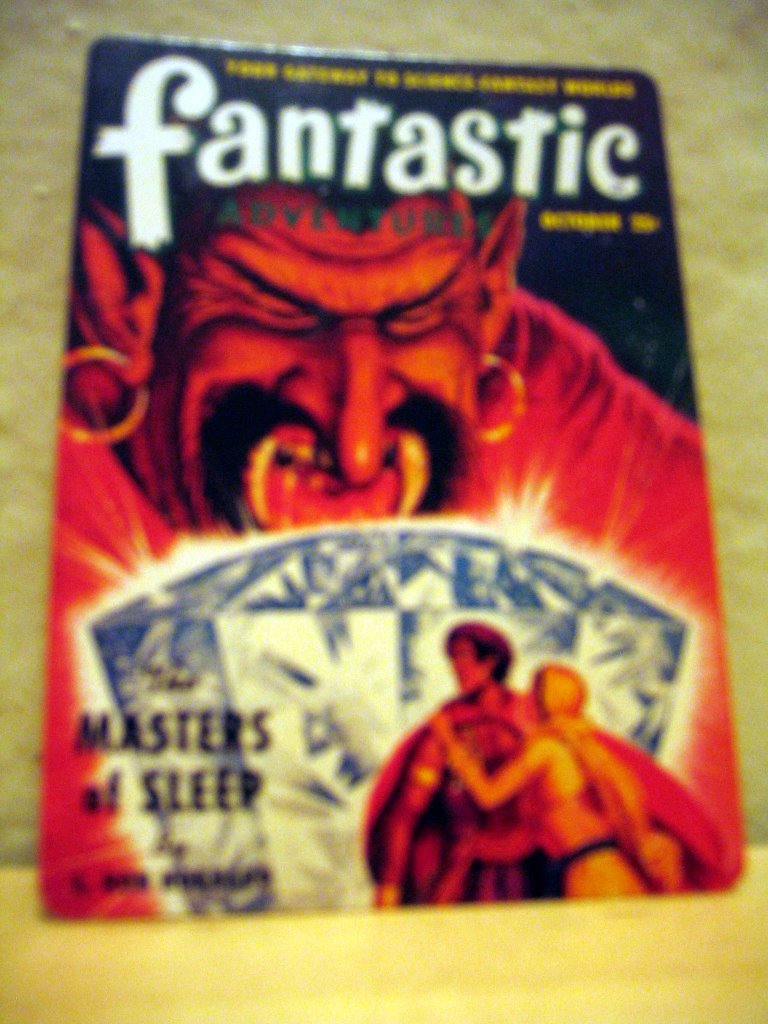
While strolling through the Festival of Books, my friend and I came upon a man from the Galaxy Press booth, throwing what appeared to be decks of cards to people walking by. I already have a favorite deck of cards, but A. tracked back to catch one, only to turn and run when she realized they were Scientology cards. This, of course, made me determined to take a deck home. As you can see above, each card is bedecked with a cover of L. Ron Hubbard's pulp fiction "classic," Masters of Sleep. The deck itself is an advertisement for the subscription-only series of all Hubbard's pulp fiction, which can be ordered for $12 a pop. The face of the cards lists brief synopses, such as "THE TRAMP by L. Ron Hubbard: Doughface Jack acquires phenomenal mental powers after a brain operation. He can instantaneously heal or kill, or make the old young. And goaded on by a beautiful woman, he is propelled toward the ultimate seat of power." I was always under the impression that contemporary Scientologists were not rushing to highlight Hubbard's literary origins and fondness for fictionalization, but I guess I was wrong.

With the devil in my purse, I moved on to see Joyce Carol Oates in conversation with Michael Silverblatt. I've seen JCO once before in New York, and each time, I am struck by her slight frame and charmingly quirky voice and worldview. She read a short story titled "Small Avalanches" from what she referred to as her "tombstone," High Lonesome: Stories 1966-2006. The story seemed to be a variation on "Where Are You Going, Where Have You Been?" A young girl is first tormented by a sexual predator and then taunts him as he falters in the chase up a rocky hill and possibly has a heart attack. Oates's reading was pretty mesmerizing, and then she chatted with Silverblatt and answered questions from the audience. She was gracious even in the face of some bozo who wondered whether we would later discover her books were actually all written by a committee of men.

All in all, another excellent festival.
-

Tuesday, May 02, 2006

prose is the theater of the mind...


...was Chip Kidd's explanation of why he chose a traditional (as opposed to graphic) novel format for his 2001 publication The Cheese Monkeys. Kidd is known for wearing many hats, most famously perhaps as book designer, having David Sedaris's Naked among others on his roster. One of the stories he told while in conversation with Charles Solomon on Saturday was how he requested Sedaris bring a pair of his underpants to lunch - briefs that were later deemed too sexual for the cover. My favorite Kidd tale was how he called up Chris Ware and said "Hey, I want to be your friend." I have actually been discouraged from doing this quite recently (with someone other than Chris Ware), and while I may still not ever follow through with such a bold proposition, it's nice to know there's a precedent.

My next panel was The Art of the Short Story with Thane Rosenbaum, Bret Anthony Johnson, A.M. Homes, and Tod Goldberg. Tod has a better wrap-up of it than I could probably provide, so I'll send you over there. When you return, I'll have a report from the Joyce Carol Oates/Michael Silverblatt powwow.
(Forgive the awful photo...)

I bet heaven is a lot like the festival of books


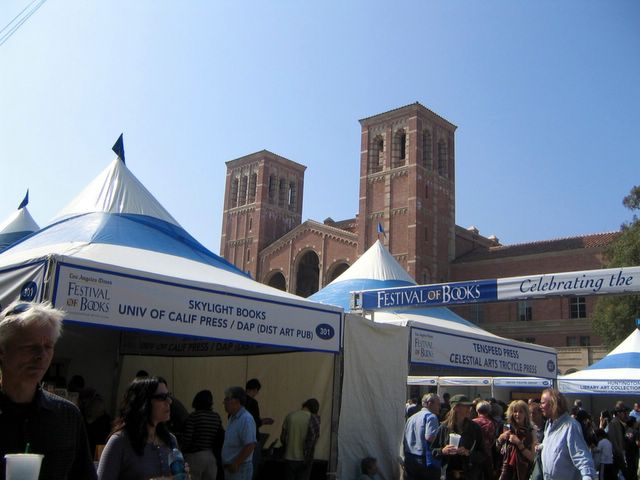
My favorite time of year out here is when the L.A. Times Festival of Books rolls around. Between the beautiful UCLA grounds, the gathering of the happy & book-loving masses, the impressive organization of the festival, and the writers writers everywhere, I am completely blissed out. I was only able to attend on Saturday this year, but I got my fix.

I started out the day at the "Fertile Ground: Building a Creative Community" panel. I'm in the process of trying to sort out just how to do just that, so I was interested in what the panelists had to say. (It's becoming a festival tradition for me to feel some vague disappointment when moderator Richard Rayner works his wife into the conversation.) John Baxter thinks the place to build a community is Paris, so he was little help. Michael Walker's new book explores the Laurel Canyon music scene in the 1960s, and while it seemed very interesting, it's 2006 and I doubt I could afford to live there. Unsurprisingly, Carolyn See's advice and wisdom were most helpful and available for purchase in the form of her excellent book, Making a Literary Life: Advice for Writers and Other Dreamers. During the panel, she read an excerpt from the section "Hang Out with People Who Support Your Work," a task much easier said than done. After the panel, I had Carolyn See sign a copy of her book, and she was kind enough to recall a phone conversation we had last summer about my dissertation. Her inscription reads: "The end times can be good times!" Amen.

Reports from the Chip Kidd panel next...
-