containers for coins, keys, and candy for cuties
What fashion folks in the 1930s thought we would be wearing now:
Via Jezebel
The New Yorker has an excerpt from Jonathan Lethem's forthcoming novel.
Ava let him know they were to sleep in the bed together that first night, joining him there and, then, when he tried to cede it to her, clambering atop him on the narrow sofa to which he’d retreated, spilling her sixty or seventy writhing pounds across his body and flipping her head up under his jaw in a crass seduction. That wasn’t going to be very restful for either of them, so it was back to the twin-size mattress, where she could fit herself against his length and curl her snout around his hip bone. By the end of the second night, he had grown accustomed to her presence.
I reviewed Will You Take Me as I Am: Joni Mitchell's Blue Period
for this Sunday's LA Times.
"Will You Take Me" is also a work of literary criticism. Mercer references Plato's allegory of the cave and Sylvia Plath, James Joyce and Annie Dillard. She does not shy away from tangents, some successful, as when she links the dogma of folk tradition to T.S. Eliot's criticism; and some not so, such as dips into associative logic and Foucault. As she explores the distinctions among confessional, autobiographical and personal writing, Mercer uses her subject's own words (she conducted a trove of interviews with Mitchell) to illustrate her thesis that Mitchell helped make the personal songwriters of the late '60s and early '70s the literary successors to the Beats.

"[L.A.] is the most self-referential place on Earth — a paradise for those who succeed, and a bright glaring hell for those who don’t." - Barney Hoskyns
 Eric Bogosian joined Jerry Stahl last night at the Central Library as part of the ALOUD series. (I'm averaging about a bimonthly Stahl event these days.) The two writers revealed they were old friends, joking that they may have "shared some hobbies" in the less drug-free past. They took turns reading from their latest releases - Bogosian's Perforated Heart

 Other topics discussed include Bogosian's previous novels Mall and Wasted Beauty, The Caine Mutiny Court Martial, Liev Schreiber in a revival of Talk Radio, Stahl's work on a new film about Hemingway, finding journals of the younger you, being invisible vs. being a creepy old guy, anger, revenge, Frank Zappa, committing to domesticity, Bret Easton Ellis, Joseph Mengele, born-again prostitutes, syringe collections, the detective genre, books as developmentally challenged children, the Mayfair Apartments, the Hellfire Club, ice cubes, blonde on bagel sex, acting, and Warhol's From A to B and Back Again.
Morgan Mies on the wonders abound in Strunk & White:
If there is an underlying metaphysical principal guiding The Elements of Style (the one with White's additional chapter) it is something like the following: language is simple, direct, and expressive… except that it's magical, dynamic, and unfettered. White looks at Thomas Paine's famous sentence, "These are the times that try men's souls." He tries switching it around to, "Times like these try men's souls." It crashes to the ground. Why? We simply do not know. No explanation seems adequate. Try it yourself. Try to actually explain, with reasons and causes, why the one sentence sets the aforementioned soul stirring while the other practically extinguishes it. As White says, we usually end up explaining the difference with such words as "rhythm" and "cadence." But what are we really explaining with those words? We're still just saying that one sentence simply sounds better than the other. That's not explanation — it’s obfuscation. The first sentence is better and we damn well know it. We don't know why. But we know it, as certain as the hand in front of one's face, the rain falling on the plain.
 Jeanette Winterson on Italo Calvino and his Cosmicomics:
Calvino was a writer who preferred to disappear. He did not enjoy talking about himself, finding that the facts of life were a kind of Medusa's stare, as he puts it in his essay Lightness, published in 1985. He used his fiction to escape himself, and the weight of the world. This was not by any means escapism; it was his answer to the eternal question: What is reality?
This 1981 TV news report speculates on a future where you can read the newspaper on your computer.

"I have always imagined that Heaven would be some kind of library." - Jorge Luis Borges
Gothamist tours the New York Public Library: Above is Charles Dickens's desk. More photos here.
Aleksander Hemon's The Lazarus Project

6. Metropolis Coffee Shop 1039 W. Granville Ave.
I wrote substantial parts of "The Noble Truths of Suffering" at Metropolis. I can write anywhere as long as there is good coffee available, for I am a militant caffeine addict and a terrible coffee snob. Whether by the Turkish coffee I make at home, or by what the good people of Metropolis provide, my fantasies are fueled by what ought to be, according to a Turkish proverb, black as hell, strong as death and sweet as love. I take no love in my coffee.
From the 1999 Mojo interview:
Tell me about the "perverted doctor" you play in the forthcoming film Mystery Men.
Perverted? I don't know. There's a scene with a woman in her nineties at a rest home where we watch television and I make advances, but I wouldn't necessarily call that perverted. Dr. Hiller likes older women, and I guess it's just so radically different from the Hollywood cycle of older men with younger women. What's really perverted is these old-timers going and picking up these young gals. I respect maturity and longevity.
Sigh. Flutter.

"So cheat your landlord if you can and must, but do not try to shortchange the Muse. It cannot be done. You can't fake quality anymore than you can fake a good meal." - William Burroughs
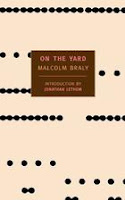
I could not stop talking about how much I was enjoying this book. I'm sure people tired of my "It's Oz in a book!" refrain, but it is. The characters in this 1967 prison novel are intriguingly complex, and I seriously cannot remember a more gripping climax to a fiction narrative. I was bent on writing a film adaptation, but I see it's already been done. Remake perhaps?
Wanting to add another LA text to my research, I picked up this novel - a farcical tale of a porn producer, his Christian martyr sister, and sundry other characters, somehow inevitably including a horny dwarf. The plot is pretty over the top, but then again, it is LA. The quick jumps between character perspective keep the story moving at a compelling pace.
A 16-year-old paranoid schizophrenic escapes from an institution and rides the New York City subway system on a mission to save the world from global warming by getting laid. I will not mention the obvious comparison everyone else is making. It's a pretty brilliant premise that is executed without needless exposition. One of the blurbs on the back of my copy referred to the novel having the pace of a thriller, and it does, while still respecting the reader's intellect.
I read this collection of stories in one sitting. Freed writes of the lives of women - in the U.S. and South Africa, primarily - who struggle to reconcile their scrabbling toward desire and happiness with the fact they have to live in the world. It seems to be an older world, although most of the stories were initially published in the late 1980s and early 1990s.
Musicians from all over the world sing "Stand By Me" - better than swine flu any day.

